- E
- I
- S
- N
- T
- F
- J
- P
The MBTI Personality Test: A Complete Guide to Understanding Your Personality Before Deciding to Marry
Four dimensions, sixteen types, and one question that matters before marriage: how do you think, and how does the person you'll share your life with think?
Why do two people facing the same situation make completely different decisions? And why are some drawn to a lively social life while others prefer quiet and privacy? The answer lies in different personality types. Every person carries a unique psychological fingerprint that shapes how they think, how they deal with others, and even their life-changing decisions at work and in love alike.
A person who tends to plan ahead and stick to a schedule is often disciplined and serious at work, and may look for stability and clarity in a life partner. Meanwhile, a spontaneous, flexible person who prefers to let things develop naturally may lean, in marriage, toward more freedom and flexibility, away from a strict routine.
These differences aren't random or superficial impressions; they're the result of in-depth psychological studies that try to classify human personality within clear frameworks that can be understood and measured. Foremost among these tools is the MBTI personality test, one of the most widely used tests in the world for analyzing personality.
So what is this test? How many types does it include? What dimensions does it measure? And how can your partner's personality type affect the decision to marry and married life as a whole? That's what we'll explore in detail in Melkah's complete guide to the personality test, to help you understand yourself first, and then understand the person you'll share life's journey with.
What Is the MBTI
The MBTI personality test is an acronym for Myers-Briggs Type Indicator, one of the most widespread and widely used personality tests in the world, whether in career guidance, self-development, or even understanding human and romantic relationships.
The test is named after its creators, Katharine Cook Briggs and her daughter Isabel Briggs Myers, who developed it based on the psychological theory of the famous Swiss psychologist Carl Jung on psychological types, published in his 1921 book "Psychological Types". Briggs and her daughter noticed that Jung's theory accurately explained behavioral differences between people, so they decided to turn it into a practical tool for measuring personality. They began working on the test in the 1940s, during World War II, to help women entering the workforce for the first time choose the jobs best suited to their personalities.
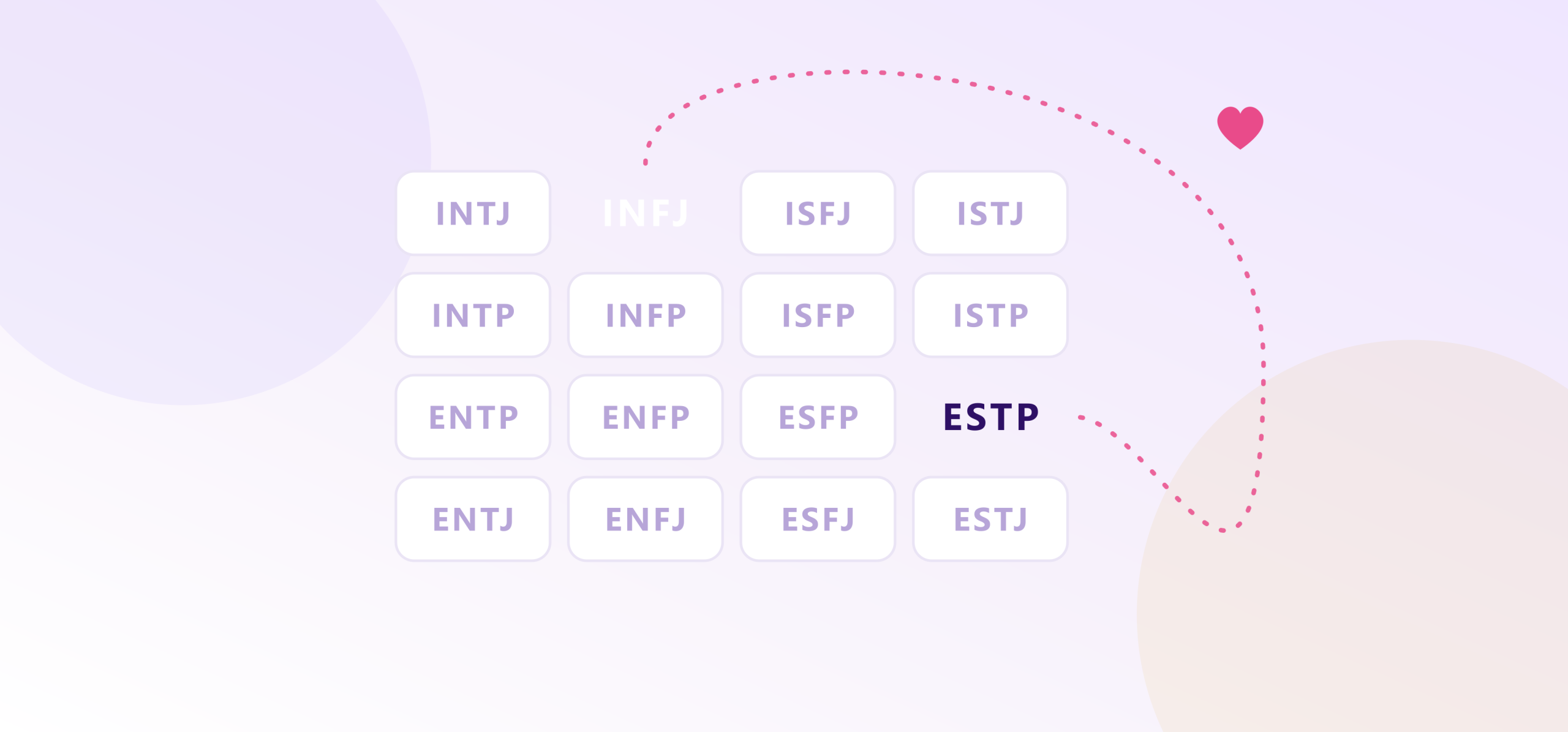
The test is based on the idea that human behavior, despite its apparent variety, isn't random; it follows relatively stable patterns and preferences that can be observed and classified. Through a set of carefully designed questions, the test places a person on four core psychological dimensions, producing one personality type out of 16 possible types, each expressed as a four-letter code, such as INFJ or ESTP, and each letter indicates a particular preference that shows how the person thinks and interacts with the world around them.
The Four Dimensions of the MBTI and the Letters for Each
The MBTI personality test measures four main psychological dimensions. Each dimension consists of two opposite poles, each represented by a letter, and the combination of these four letters forms the final personality type. Here are the four dimensions of the MBTI test and what each letter stands for:
Extraversion vs. Introversion
Extraversion vs. IntroversionThis dimension determines a person's source of psychological energy. An extravert (E) draws energy from social interaction and outside activities, while an introvert (I) draws energy from quiet, inner reflection and time spent alone.
Sensing vs. Intuition
Sensing vs. IntuitionThis dimension shows how a person takes in information. A sensing person (S) relies on tangible facts, realistic details and direct experience, while an intuitive person (N) tends to think about future possibilities, general patterns and abstract ideas.
Thinking vs. Feeling
Thinking vs. FeelingThis dimension determines how decisions are made. A thinking type (T) relies on logic and objective analysis when making decisions, while a feeling type (F) relies on personal values and consideration for others' feelings.
Judging vs. Perceiving
Judging vs. PerceivingThis dimension reflects daily lifestyle. A judging person (J) tends toward organization, planning ahead and sticking to schedules, while a perceiving person (P) prefers flexibility, spontaneity and openness to new developments without being tied to strict plans.
Types of the MBTI Personality Analysis Test
The personality types test MBTI has sixteen different types resulting from combining these four dimensions. Each type represents a unique mix of psychological preferences that shapes how a person thinks, interacts with their surroundings and makes decisions. No type is better than another in absolute terms; each has its own strengths and challenges. The goal of classifying these types isn't to put people into rigid molds, but to offer a frame of reference that helps a person understand themselves more deeply and understand those around them better, whether at work or in personal and romantic relationships. These sixteen types have become a common reference many people use to describe their temperament and preferences in daily life. Below is a list of the 16 MBTI types, with a brief overview of each:
ISTJThe Inspector An organized, realistic person who follows rules and responsibilities and prefers clarity and stability in every detail of life.ISFJThe Defender A calm, loyal person who cares about helping and looking after others, and gives high priority to emotional and family security.INFJThe Advocate A dreamy, idealistic person who cares about the deeper meaning of things and always seeks to make a positive impact on the lives of those around them.INTJThe Architect A strategic, independent thinker who tends toward long-term planning and solving problems in a purely logical way.ISTPThe Crafter A practical, calm person who loves exploring things hands-on and deals with problems realistically and with quick wit.ISFPThe Artist A sensitive, gentle person who appreciates beauty and detail and prefers to express feelings in a calm, indirect way.INFPThe Mediator An emotional, idealistic person who looks for harmony and meaning in everything they do and tends to feel deep empathy for others.INTPThe Thinker An analytical, curious person who loves exploring complex ideas and prefers logic over emotion when making decisions.ESTPThe Entrepreneur A bold, practical person who loves adventure and challenges and handles situations quickly and with high self-confidence.ESFPThe Performer A sociable, fun-loving person who enjoys attention and living in the moment without overthinking the future.ENFPThe Campaigner An enthusiastic, creative person with plenty of energy for connecting with others, always looking to discover new possibilities.ENTPThe Debater A smart person who is bold in putting forward ideas, loves debate and challenging conventional views in a flexible, innovative way.ESTJThe Executive An organized natural leader who tends to establish order and take responsibility, and values efficiency and discipline.ESFJThe Consul A sociable, cooperative person who cares about others' comfort and seeks to build strong relationships based on mutual support.ENFJThe Protagonist An inspiring natural leader who cares about developing those around them and has a great ability to positively influence others.ENTJThe Commander An ambitious, decisive person who tends to set big goals and work hard to achieve them with confident leadership.
The Purpose of the MBTI
On a personal level
On a personal level, the MBTI test helps individuals understand themselves more deeply and recognize their strengths and challenges, enabling them to work on developing themselves more consciously instead of trying to change their basic nature.
On a professional level
On a professional level, the test is widely used in recruitment and career guidance, as it helps individuals choose career paths that suit their personality. Some organizations also use it to understand team dynamics and improve communication between employees.
On a social and emotional level
On a social and emotional level, the test plays a clear role in understanding the nature of human relationships, helping people recognize the causes of disagreements that may arise between them and their partners or family members, which often come down to different ways of thinking and making decisions rather than bad intentions. This makes the test an effective tool for improving communication and building more understanding, mindful relationships, and an important aid before making life-changing decisions such as marriage, through a deeper understanding of oneself and one's potential life partner.
Personality Compatibility in Marriage According to MBTI
One of the most practical and important uses of the MBTI personality test is analyzing how compatible two partners are within a marriage. Marriage is a long-term daily partnership that requires real harmony in ways of thinking, approaches to problems, and the values on which each person bases their decisions.
In general, many specialists who apply the test believe that compatibility in the Intuition and Sensing dimensions (S/N) and Thinking and Feeling (T/F) often has a big impact on how well partners get along, since differences in how information is taken in and decisions are made can be a source of deep understanding or recurring disagreements, depending on how aware each partner is of the other's nature. For example, an intuitive person (N) may get along better with a partner who shares their vision of the future and thinking about possibilities, while a sensing person (S) may feel more comfortable with a partner who shares their focus on reality and concrete details.
As for the Extraversion and Introversion dimension (E/I), partners don't necessarily need to be the same type, as each can complement the other: an extravert may bring liveliness and sociability to the relationship, while an introvert offers a space of calm and emotional depth. The same applies to the Judging and Perceiving dimension (J/P), where the organized person (J) brings commitment and stability, while the flexible person (P) adds spontaneity and fun to married life.
Dimensions where similarity helps
S/NHow you take in information: future vision or concrete detailsT/FHow you make decisions: logic and analysis, or values and consideration for feelings
Dimensions where differences can complement
E/ISocial liveliness from one partner, calm and emotional depth from the otherJ/PCommitment and stability from one partner, spontaneity and fun from the other
It's important to stress that the results of the MBTI personality test shouldn't be used as a definitive verdict on whether a relationship will succeed or fail. Real compatibility in marriage depends on many factors, such as shared values, emotional maturity and a sincere desire to build a stable family, along with the ongoing effort both partners make to understand each other. The test remains a valuable aid that gives both partners a deeper awareness of themselves and each other, making it easier to communicate better and avoid many of the misunderstandings that can arise from their different natures.
Understand yourself, then look for someone who understands you
On Melkah, serious introductions start from verified accounts, and families can take part through family accounts.
Start with MelkahConclusion: The MBTI A tool for understanding, not for judging
The MBTI personality test gives you a chance to understand how you think and handle situations, and helps you discover some of the differences between you and your potential life partner. But knowing a personality type alone isn't enough to judge whether a marriage will succeed or fail; a marriage is built on shared values, respect, the ability to talk things through, taking responsibility, and handling disagreements maturely.
So you can use your test result as a starting point for a deeper conversation with your partner about your expectations of marriage, managing money, relationships with family, raising children, privacy, and how you deal with pressure and disagreements. The better each partner understands the other's needs and way of thinking, the clearer the path to a stable, mindful relationship becomes.
Your type explains how you think, but it doesn't decide who you marry. That decision is made by values, dialogue and respect.
FAQ
Is the MBTI test result fixed for life?+
To some extent. The MBTI test result is usually relatively stable in its core preferences, but it isn't completely rigid. Some aspects of personality can develop over time and with life experience, especially in the dimensions related to handling everyday situations, while the deeper core tendencies stay more stable in the long run.
Does a difference in MBTI types between partners mean they're incompatible?+
No, different MBTI types between partners don't necessarily mean incompatibility. Some dimensions, such as Extraversion vs. Introversion, can let one partner complement the other instead of creating conflict between them. What matters is each partner's awareness of the other's nature and way of dealing with things, not a complete match of types.
Can you rely on the MBTI test alone to decide on marriage?+
No, you can't rely on the MBTI test alone for a marriage decision. The test is a tool to help you understand yourself and your partner, not a decisive reference for making the decision on its own. A successful marriage depends on many factors, such as shared values, emotional maturity and ongoing effort from both partners, and the test remains a way to support that understanding without replacing these other factors.